Our Commitment to Action
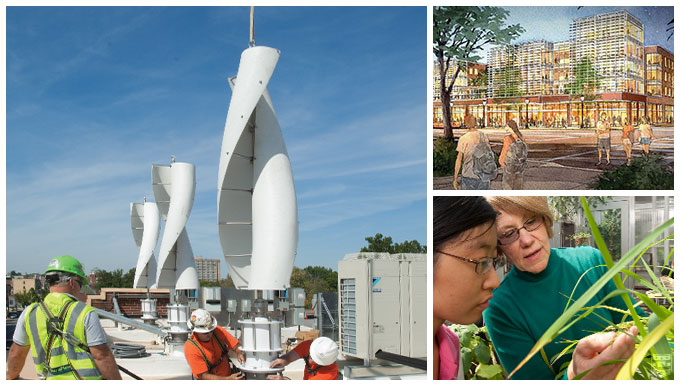
Washington University is committed to reducing greenhouse gas emissions 22% by 2020. To advance this goal, the university has established an Energy Conservation Investment of $30 million.
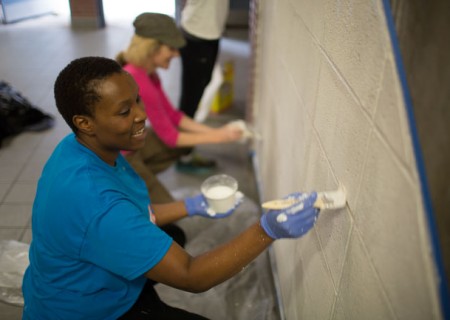
More than 250 students, faculty, staff and friends from across the university gathered at Gateway STEM High School last Saturday, March 30, to help lay the groundwork for this weekend’s… Keep reading →
Public service and global leadership are at the heart of the mission of Washington University in St. Louis. Our students, faculty and staff are leading the way to address urgent global challenges in the CGI’s five focus areas: education, environment and climate change, peace and human rights, poverty alleviation and public health.
Commitments to Action are new, specific, and measurable initiatives that address social or environmental challenges on campuses, in communities, or in different parts of the world. Proposed by an individual or a group, commitments translate practical goals into meaningful and measurable results. WUSTL is proud of all 200 of our students who have made a commitment to action through CGI U. Here is a sample of the projects our students are working on.
"Making Vegetables Fun: The St. Louis City Healthy Eating Initiative," addresses childhood obesity in St. Louis. School children will learn about and practice healthy eating in the classroom, and the program will teach an appreciation for healthy eating, as well as provide assistance to low-income families with ideas for healthy foods the children enjoy.
The Washington University Marshall-Brennan Project places law students in St. Louis high schools to teach a semester-long course on students’ constitutional rights in order to address a fundamental civics gap in American education. The commitment “Addressing Civic Education in St. Louis” will expand the Project to reach hundreds of St. Louis high school students within five years, and ultimately aims to make the Project a permanent institution for educational progress in the St. Louis area.
This project seeks to turn a single room in St. Louis into an overpowering art exhibit of human strength and courage. Beginning with a social media campaign, the project is asking for stories, artwork, photographs, and other creative expressions by all individuals impacted by gender-based violence – not just the survivors themselves.
Madeleine Polk is developing a means of replicating and implementing Systems Thinking curriculum in schools to better equip the next generation of students to address the local, national, and global issues they face. Because of its broad applicability, Polk anticipates the designing of new materials will allow for more teachers to see the relevance of Systems Thinking for their students and consequently begin to use it to aid students in problem solving processes.
This group seeks to create a partnership with the St. Louis Charter School to increase the school’s volunteer base by 20 percent, specifically in the field of male student mentorship, and to increase educational resources, including textbooks and other school supplies, by 10 percent over the next three years.
D*Serve (Design Serves) aims to inspire youth who live in disinvested neighborhoods by providing them experience and education in design and civic leadership. The idea is to help teens first identify what exactly it is they want – and deserve – in their community, and then guide them toward reinvigorating culture, socio-economy, and physical spaces through sustainable innovations.
In cities throughout the world, years of contamination have rendered large swaths of land unfit for habitation, development or food production. Interactive Living Landscape aims to demonstrate that vacant urban lots can be productively landscaped in ways that not only heal the soil, but also help improve the health of the wider community.
The goal of the Correctional Education Reform Through Technology program is to equip the inmates of St. County Jail and St. Louis County Juvenile Detention with the literacy, mathematics, and critical thinking skills necessary in order to obtain their GEDs and reduce their rate of relapse.
We are using Storify to curate the preparations, applications, and energy leading up to CGI U at Washington University in April, 2013. Be a part of the conversation! Tweet, post to Facebook and Tumblr, or send us links to blogs. Help us build the story for Washington University and CGI U.
While CGI U sessions are not open to the public, everyone has the opportunity to engage in a number of ways. You can:
Everyone is welcome to attend a live feed of the CGI U sessions featuring President Bill Clinton and TV personality Stephen Colbert in Tisch Commons on the DUC movie screen. Additional sessions will be presented in the DUC Fun Room.
April 5, 6:30 p.m.
Opening Session by President Bill Clinton
April 6, 3:30 p.m.
Closing Remarks by Stephen Colbert
Press registration is now open to members of the media. To apply, please complete the press access form on the CGI U website.
CGI U 2013 Meeting Agenda
For the complete participant details and meeting agenda, including plenary sessions, skill and working sessions, and the service project, visit cgiu.org.